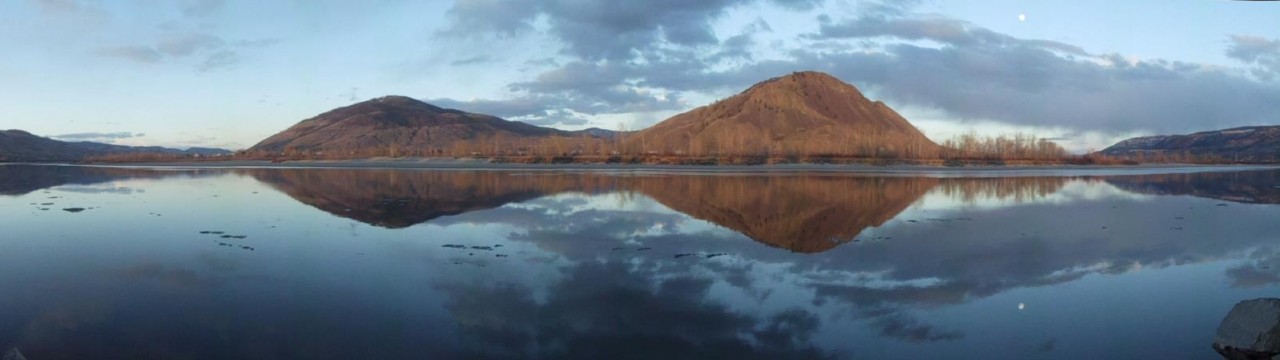

On June 11th, the Cooks Ferry Indian Band (Nlak’apamux) hosted the First Annual Unity Gathering. It was a day to recognize the importance of the Laurier Memorial of 1910 in the fight for rights and title. The ceremonies took place, where the Nicola and Thompson rivers meet, in the new Chief Tetlenitsa Memorial Outdoor Theatre.
Lynda Ursaki designed this “performance space” while working as an intern at Patrick R. Stewart Architect in Chilliwack. She’s the daughter of Cooks Ferry Indian Band elder Don and Lorna Ursaki and granddaughter of Dorothy Ursaki (nee Walkem).
Her journey as an architect began by listening to her father and grandmother recount stories of traditional building methods. Lynda took those lessons with her to Dalhousie University in Halifax, Nova Scotia where she did her Master’s Thesis in First Nations Architecture. Central to Lynda’s studies and work is the question, “How do I make traditional technology relevant to today?” The answers are evident in the Chief Tetlenitsa Theatre.
The theatre’s design is based on the pithouse. People enter by the north and pay homage to the east. “People gather in a circle,” Lynda explained, “tighter in the centre and looser on the outside rings.” Accordingly, the main performance space is in the centre, like the fire pit, and stories are told “in the round.” The surrounding seating and walking ramp provide a sense of closeness to others, clear sightlines and ease of movement throughout. “The building wraps itself around you,” Lynda said.
Excellent sound quality wherever you sit in the theatre adds to that sense of closeness. The underside of the roof is made from 2×4 and 2×6 Beetle-kill Pine wood – an undulating surface that dampens echo and disperses sounds coming from outside of the performance space. Traditionally, poles were treated with a “pitch and burn” method. Lynda’s grandmother, remembering how she saw it as a child, said that a log end was first rolled in pine pitch, then, through a fire, creating a preservative seal. For this building, the poles are protected by a modern method of “pitch and burn,” supplemented by minimal flashing.
“First Nations have been great at learning new technologies and making them our own,” said Lynda. “It’s a sign that our culture is a live culture, adapting and moving forward.” She’s grateful that the contractors and consultants working on this project were “enthusiastic” about her vision for the building’s design and construction.
Lynda spoke of how much it meant to her to have the opportunity to honour her culture and to do something for her people. “Sometimes you feel like you don’t have the tools to deal with all the stresses of today,” she said. For Lynda, the Chief Tetlenitsa Theatre “is a tool for our people to celebrate our culture and plan for our future.”
My interview with Lynda was published in the Secwepemc News during the summer of 2010.
To learn about the 1910 Memorial from the interior Chiefs to Sir Wilfrid Laurier, please follow the link below: